Data centers, new power plants and home electric bills in Evergy's Kansas territory
Made by AI agents, with a person directing and checking the work.
Independent analysis. Numbers are estimates with stated limits; see Methods.
Summary
- Large new loads are arriving fast. Evergy says it has signed contracts for about 3 GW of large customers (five data-center agreements totalling about 2.5 GW, plus about 0.5 GW of others such as Panasonic), with 2-2.5 GW of expansions and 1-2 GW more in advanced talks, mostly after 2030 [8][9]. Its whole fleet today is about 15.8 GW [9]. These are company-wide figures for Kansas and Missouri; Evergy does not break them out for Kansas Central, which serves Lawrence.
- Two new gas plants are being built for Kansas Central. Regulators approved Kansas Central's half-share of two 710 MW gas plants, about $1.59 billion ($788.75M for Viola, now named Chisholm Trail, and $800.52M for McNew), plus a $228.1M solar farm in Douglas County (Kansas Sky) [2]. Construction of Chisholm Trail began May 12, 2026 [7].
- Rules for data centers. Since November 2025, new customers of 75 MW or more pay under a Large Load Power Service tariff: contracts of at least 12 years (17 with ramp-up), a minimum bill of 80% of contracted demand whether used or not, collateral of two years of minimum bills, exit fees, and direct assignment of upgrades built only for them [1]. Transmission network upgrades are allocated by the regional grid operator (SPP) under federal (FERC) rules, not by the state [1].
- What homes pay first: the construction rider. A 2024 state law lets Evergy charge customers a return on the gas plants while they are built, starting no sooner than 365 days after construction begins [6]. Using the 8.45% pre-tax return and the 45.37% residential share set in the 2025 rate case [4], that adds roughly $2-$4 a month to a typical home while Chisholm Trail is built, and up to about $7.90 a month if both plants are fully built before entering service (our estimate).
- After the plants run, who pays depends on whether large-load revenue covers them. If the large-load tariff works as designed, homes pay none of the new plants' fixed cost. If existing customers end up carrying a quarter, half or all of it, a typical home would pay roughly $2-$3, $4-$6 or $8-$12 a month more (illustrative range, fixed costs only).
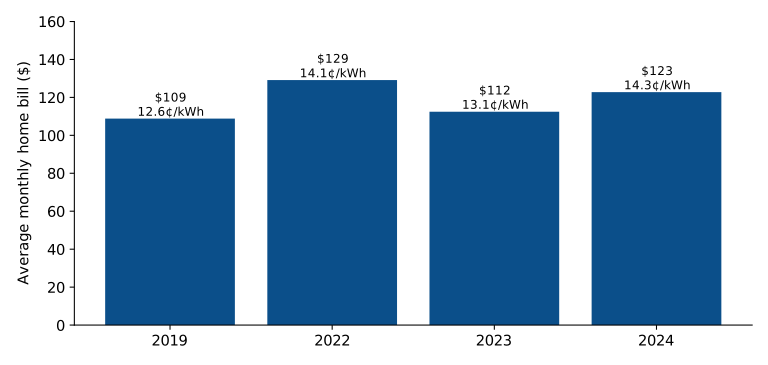
- For context, the average Kansas Central home paid about $123 a month in 2024 (14.3 cents per kWh) [11], and the October 2025 rate increase added about $8.47 a month [3].
1. The question
Utilities across the country are adding power plants and lines for data centers. The concern for households is simple: if a utility builds for a few very large customers, do other customers end up paying? This report looks at Evergy Kansas Central, which serves Lawrence, Topeka, Wichita and much of eastern and central Kansas (about 735,000 customers) [5], using regulators' orders, state law, federal data and the company's own statements.
2. How much new demand, and what is being built
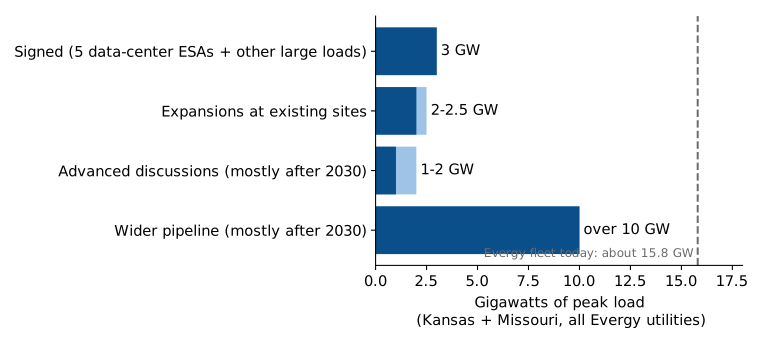
Evergy reports retail sales growth of 7%-8% a year expected through 2030, driven by large customers, and says a large data center started operating in March 2026 [8]. It expects signed large loads to reach a combined peak of 2.05-2.25 GW by 2030 [8]. Five data-center agreements are with Google (two), Meta, Digital Realty and Beale [8]; Evergy has not said publicly which state or utility each is in.
For Kansas Central, regulators approved in July 2025 [2]:
| Asset | Type | Kansas Central share | Kansas Central cost | In service |
|---|---|---|---|---|
| Viola / Chisholm Trail (Sumner County) | 710 MW gas combined cycle | 50% | $788.75M | by Jan 1 2029 |
| McNew (Reno County) | 710 MW gas combined cycle | 50% | $800.52M | by Jan 1 2030 |
| Kansas Sky (Douglas County) | Solar | 100% | $228.1M | not stated in release |
The Commission called the frequency and size of Evergy's rate cases "troubling" and told the company to pace investment to load growth and to consider cheaper options such as demand response [2]. Evergy has also filed notice of another Kansas application for a gas plant, a solar farm and a battery [8]. Evergy says the additional load beyond the 3 GW already signed will need more generation and capital [8][9].
3. Who pays for what
| Cost | Who pays under current rules | Source |
|---|---|---|
| Energy and demand to serve a large load (75 MW+) | The large customer, through Large Load Power Service rates designed to cover Evergy's incremental cost | [1] |
| Minimum bills | Large customer pays at least 80% of contracted demand monthly for 12-17 years, with two years' collateral and an exit fee | [1] |
| Upgrades needed only for one large customer | Directly assigned to that customer | [1] |
| Transmission network upgrades | Allocated by SPP under FERC rules; in Kansas Central bills, homes carry 43.32% of the transmission delivery charge | [1][4] |
| New gas plants during construction | All existing customers through the CWIP rider; homes 45.37% | [4][6] |
| New plants once in service | Set in the next Kansas Central rate case | [2][4] |
| State sales tax on data-center construction and equipment | Exempt for qualifying projects for 20 years (state revenue foregone, not on electric bills) | [10] |
Kansas also passed a 20-year sales-tax exemption for qualifying data centers that invest at least $250 million and create 20 jobs (2025 Senate Bill 98); electricity purchases are not part of that exemption [10]. That is a state tax decision, separate from electric rates.
4. Effect on a typical home bill: scenarios
These are illustrations of how bills could move under different cost-sharing outcomes. They are not forecasts, and they cover only the new gas plants' fixed costs (not fuel, transmission or future rate cases).
4a. During construction (the CWIP rider)
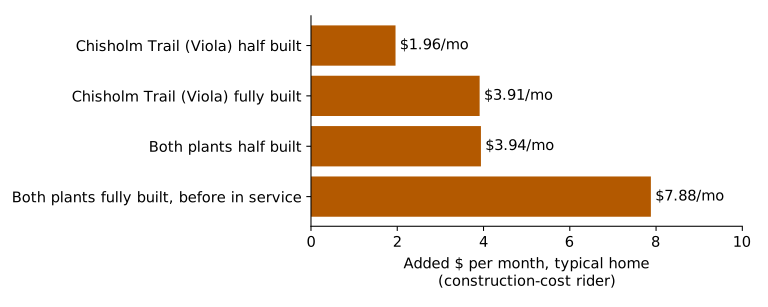
| Construction stage | Balance | Yearly charge (all customers) | Typical home, per month | Cross-check |
|---|---|---|---|---|
| Chisholm Trail (Viola) half built | $394M | $33.3M | $1.96 | $2.21 |
| Chisholm Trail (Viola) fully built | $789M | $66.6M | $3.91 | $4.41 |
| Both plants half built | $795M | $67.1M | $3.94 | $4.44 |
| Both plants fully built, before in service | $1,589M | $134.3M | $7.88 | $8.89 |
4b. After the plants enter service
To turn a plant's capital cost into a yearly cost we use an assumed fixed charge rate of 9%-13% a year (return, depreciation, taxes, fixed upkeep); this is an assumption, not a filed number. We then assign 45.37% to homes, the residential share used for the construction rider [4], and divide by Kansas Central's 644,314 residential customers in 2024 [11]. As a cross-check, the 2025 rate case raised revenue $128M and a typical home's bill $8.47 a month [3]; scaling by that ratio gives results within about 15% of ours (last column).
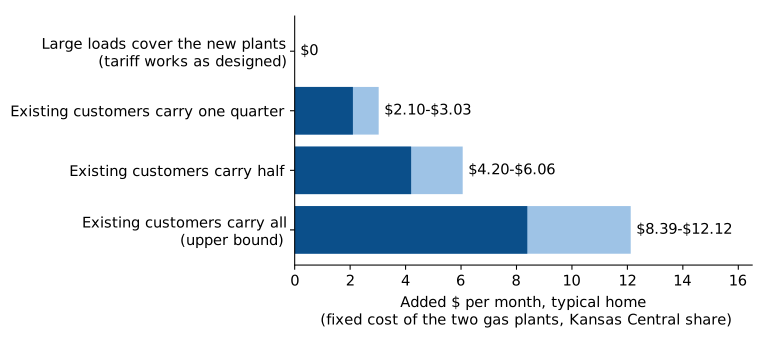
| Scenario | Assets | Yearly fixed cost | Typical home, per month | Share of 2024 average bill (high) | Cross-check (high) |
|---|---|---|---|---|---|
| 1. Large loads cover the new plants (tariff works as designed) | gas plants only | $143M-$207M | $0 | 0.0% | $0.00 |
| 1. Large loads cover the new plants (tariff works as designed) | gas plants + Kansas Sky solar | $164M-$236M | $0 | 0.0% | $0.00 |
| 2. Existing customers carry one quarter | gas plants only | $143M-$207M | $2.10-$3.03 | 2.5% | $3.42 |
| 2. Existing customers carry one quarter | gas plants + Kansas Sky solar | $164M-$236M | $2.40-$3.47 | 2.8% | $3.91 |
| 3. Existing customers carry half | gas plants only | $143M-$207M | $4.20-$6.06 | 4.9% | $6.84 |
| 3. Existing customers carry half | gas plants + Kansas Sky solar | $164M-$236M | $4.80-$6.93 | 5.6% | $7.82 |
| 4. Existing customers carry all (upper bound) | gas plants only | $143M-$207M | $8.39-$12.12 | 9.9% | $13.67 |
| 4. Existing customers carry all (upper bound) | gas plants + Kansas Sky solar | $164M-$236M | $9.60-$13.86 | 11.3% | $15.63 |
Who benefits. If large customers pay their full cost, existing customers can benefit because fixed costs are spread over more sales; Evergy says data-center revenue cut its pending Missouri Metro rate request by about $25M (15%) [8]. Evergy expects residential increases "in line with or below inflation" for most customers [8]. These are company statements that regulators have not yet tested in a Kansas Central rate case.
Who carries the risk. The tariff protects existing customers for the contract term through minimum bills, collateral and exit fees [1]. Plants last longer than the 12-17 year contracts, and the construction rider is charged before any data-center revenue arrives [4][6].
5. What could change the outcome
- Next Kansas Central rate case, when the plants enter base rates: the class allocation of their cost, including any share assigned to large-load customers [4].
- Large-load ramp speed: slower ramps mean less revenue to offset fixed costs (minimum bills apply) [1].
- Further generation: the newly noticed Kansas application (gas, solar, battery) [8].
- Transmission: SPP/FERC cost allocation for network upgrades [1]; the Commission set a 9.7% return for the transmission delivery charge over one Commissioner's partial dissent [3].
6. Limits
- Company-wide large-load figures are not broken out for Kansas Central. A Kansas-only split would need Evergy's filings in the LLPS and next predetermination dockets.
- The 9%-13% fixed charge rate is an assumption; the share of costs "on existing customers" is a scenario input, not a finding.
- The construction-rider share for large-load customers is not set in the 2025 order (they were not yet a class); we assume the residential share stays at 45.37%.
- EIA-861 data for 2025 were not published at the time of this build.
- A reality check: EIA's 2024 average residential use for Kansas Central (860 kWh a month) is close to the 900 kWh "typical home" the Commission uses [3][11].